A FESTIVAL WEEK FOR THE SECOND TIME
Encouraged and inspired by the remarkable acclaim that the „Johann Strauss Festival Week“ had received both at home and abroad in June 1949, the Johann Strauss Society resolved to establish an annual Festival Week of Viennese Music each June. However, the intention was no longer to devote the programme exclusively to the music of Johann Strauss; instead, his works were to be presented in dialogue with compositions by other composers who had likewise conquered the world from Vienna.
Accordingly, from 17th to 24th June 1950, the Society held a „Festival Week of Viennese Music“. As in the preceding year, the event was placed under the honorary patronage of the Austrian Minister of Education, Dr. Felix Hurdes, and the Mayor of Vienna, Dr.h.c. Theodor Körner.
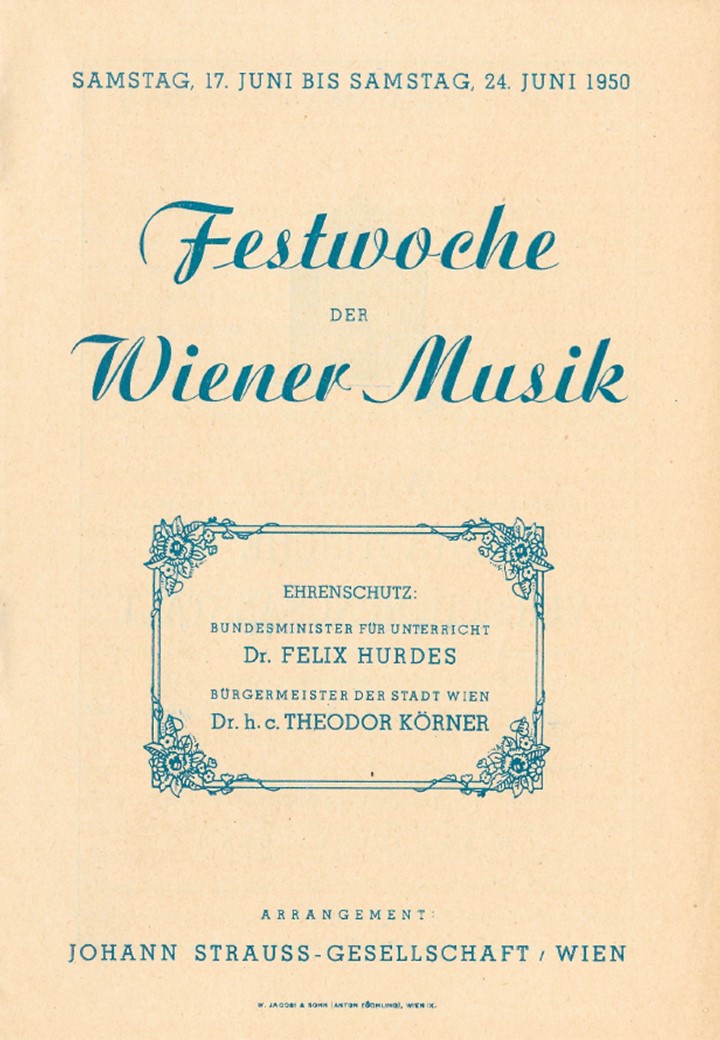
The programme featured works by Gluck, Haydn, Mozart, Beethoven and Schubert, as well as compositions by Lanner, Joseph Strauss, Lehár, Oscar Straus, and Edmund Eysler, to name but a few.
In addition to the venues already used the previous year – the Musikverein, the Konzerthaus, and the Volksoper – the Sophiensäle and the Redoutensaal of the Vienna Hofburg were added this time. Both locations are among Vienna’s historic performance venues, where Johann Strauss the Elder and his three sons frequently appeared and premiered many of their works.

It is particularly noteworthy that the three „Vienna State Opera at the Volksoper“ performances were brand-new productions: „Der Bettelstudent“ by Carl Millöcker, „Tausend und eine Nacht“ based on music by Johann Strauss (an adaptation of his first operetta „Indigo und die vierzig Räuber“ had premiered only the year before) and „Die Fledermaus“ also took place that week. All three performances were conducted by Anton Paulik, who, like no other, endeavoured to achieve absolute authenticity. As a young conductor he had worked with musicians who had played under Johann Strauss himself; from them, Paulik had learned and adopted Strauss’s interpretative subtleties.
In „Tausend und eine Nacht“, alongside audience favourites such as Esther Réthy, Rudolf Christ, Kurt Preger, Alfred Jerger, Richard Eybner and Richard Sallaba, also Karl Farkas, the very tenor who had taken part in the first performances of the Strauss Society in 1937, appeared on stage. It was he who contributed the up-to-date couplet lyrics. With „Der Bettelstudent“, audiences experienced the legendary Adolf Rott production, which was to have more than 400 performances at the Volksoper. Finally, in „Die Fledermaus“, theatregoers were treated to yet another star-studded cast: the Burgtheater actor Fred Liewehr played Eisenstein, Hilde Güden portrayed Rosalinde, Kurt Preger appeared as Alfred, Rudolf Christ as Orlofsky, and Karl Skraup took on the role of Frosch. Skraup had won the hearts of audiences in countless Viennese films – among others alongside Hans Moser, Paul Hörbiger, and Hans Holt. The costumes for this production were designed by the Viennese fashion creator Fred Adlmüller.
With this wide range of concerts and stage performances -above all, with the diversity of composers – the Johann Strauss Society of Vienna had approached a series of events that had originated during the interwar period: between 1927 and 1937, the so-called „Vienna Festival Weeks“ had annually been held at the same time of the year. In 1947, The City of Vienna attempted to revive this idea with a „Music and Theatre Festival Week“, but this initiative was not continued in the following years. The „Festival Week of Viennese Music“ organized by the Johann Strauss Society of Vienna in 1950 – like its „Johann Strauss Festival Week“ of the previous year – was such a great success that its aforementioned intention to hold such a festival week annually was strongly reinforced. However, events took a different turn: in the following year, the City of Vienna assumed responsibility for the project and implemented it according to its own ideas. As a result, the festivals organized by the Strauss Society in 1949 and 1950 were replaced from 1951 onward by the Vienna Festival Weeks. During the first decade of their establishment, they demonstrated their connection to their forerunner, the Strauss Society, by including – except in1953 – at least one Strauss concert in their programme each year.